



To discipline a child with ADHD, stay calm, connect before you correct, and use immediate, specific praise far more often than consequences. Set a few clear family rules, give one instruction at a time, and follow through consistently every time. Skip yelling and harsh punishment. Research links both to worse behavior over time.
Key takeaways:
- ADHD is a brain difference, not a behavior choice. Punishment teaches fear, not skills.
- Immediate, specific positive reinforcement changes ADHD behavior faster than any consequence.
- Consistency beats intensity. Predictable follow-through matters more than severity.
- Your own calm comes first. A regulated parent creates a regulated child.
- Some behaviors need professional support. Asking for help is a strength.
You told your child to stop. You counted to three. You took the tablet away. Ten minutes later, the same behavior came back. If this sounds like your house, you are not failing. You are using tools built for a different kind of brain. This guide shows you how to discipline a child with ADHD in a way which fits how their brain works. It comes from our work coaching hundreds of families, including many raising kids with ADHD, ODD, autism, and anxiety.
Why Typical Discipline Fails Kids With ADHD
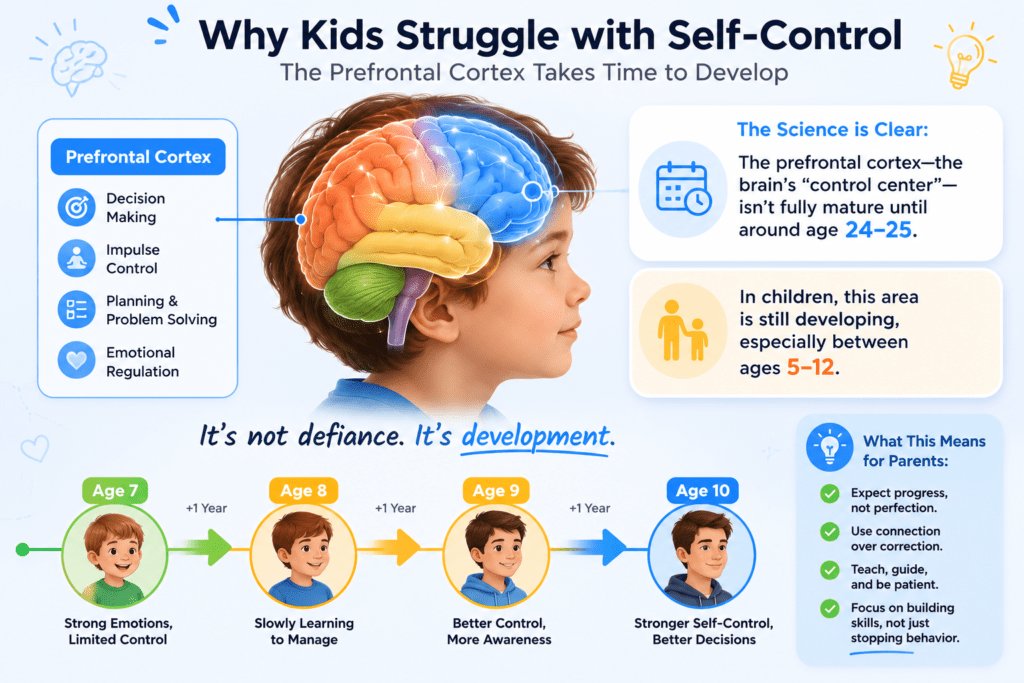
Typical discipline fails because ADHD affects executive function, the brain system behind impulse control, working memory, and emotional regulation. Kids with ADHD know the rules. Their brains struggle to apply the rules in the moment. Punishment assumes a choice was made. For an ADHD brain, the pause between impulse and action often never happened.
Three brain facts explain the pattern:
- Executive function runs behind. Children with ADHD develop self-regulation skills roughly three years later than peers, according to research popularized by Dr. Russell Barkley. A 10-year-old with ADHD often manages impulses like a 7-year-old.
- Dopamine works differently. ADHD brains under-respond to delayed rewards and delayed punishments. A consequence next weekend means almost nothing today. Feedback within seconds means everything.
- Repetition is the condition, not defiance. Your child repeating a mistake after ten corrections is a symptom of ADHD, not proof your discipline failed.
Here is the part most articles skip. Punishment does change behavior in one way. It teaches kids to hide, lie, and avoid getting caught. Clinical psychologists at the Child Mind Institute note kids who live in a constant state of punishment stop responding to it at all. The consequence loses its power. The relationship pays the price.
Expert tip from our coaches: Track one week of your corrections versus your praise. Most exhausted parents discover a ratio near 1 praise to 8 corrections. Flip it toward 5 praises for every correction and watch behavior shift within two weeks, before you change anything else.
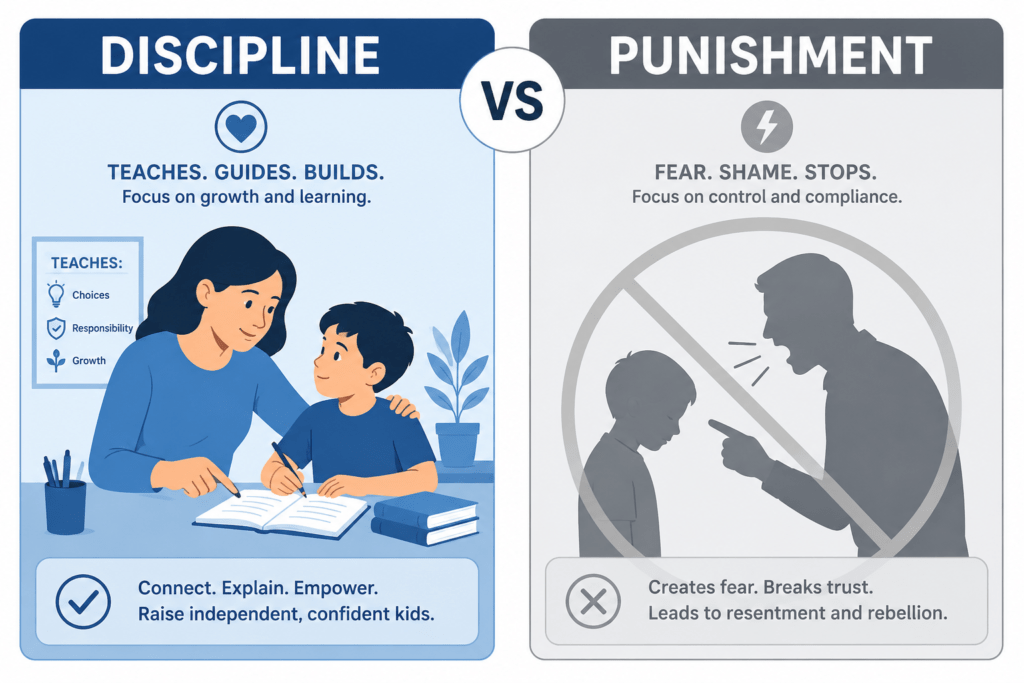
Discipline vs Punishment: The Difference Changes Everything
Discipline means teaching. Punishment means making a child suffer for a mistake. Kids with ADHD need heavy doses of the first and almost none of the second. Research summarized by CHADD found that rewards delivered quickly and often work well for children with ADHD, while punishment is generally ineffective for changing their behavior.
| Discipline (teaching) | Punishment (suffering) | |
|---|---|---|
| Goal | Build a skill | Impose pain or loss |
| Timing | Immediate, brief | Often delayed, long |
| Tone | Calm, matter-of-fact | Angry, shaming |
| Example | Lose TV time tonight to help fix what broke | Grounded for two weeks |
| Result for ADHD kids | Learning, trust | Shame, sneaking, escalation |
One number worth sitting with: by some clinical estimates, children with ADHD hear tens of thousands more negative messages than their peers by age 12. Every shame-free correction protects your child’s self-image and your bond.
The CALM Anchor Method: A 4-Step Discipline Framework
The CALM Anchor Method is our four-step framework for disciplining kids with ADHD: Connect, Anticipate, Limit, Motivate. It anchors every correction to connection first, which keeps your child’s thinking brain online and able to learn. Use it as your default response to any behavior problem.
- Connect first. Move close, get eye level, use a calm voice, and name the feeling. “You are frustrated that the game ended.” Connection lowers the stress response. A dysregulated brain learns nothing.
- Anticipate triggers. Most blowups follow patterns: transitions, hunger, screens ending, homework starting. Design the environment before the behavior. Give 5-minute warnings, use visual timers, and post picture routines.
- Limit with clarity. State one short expectation and one clear outcome. “Shoes on by the timer means we have time for the slide. No shoes means no slide today.” Then stop talking. Lectures blur the limit.
- Motivate with immediate reinforcement. Catch the turnaround within seconds. “You stopped and took a breath. Huge.” Specific praise, tokens, or earned privileges give the ADHD brain the fast feedback it needs.
Families in our coaching practice typically see fewer daily power struggles within two to three weeks of consistent CALM use. The method takes practice. Give any new approach at least three weeks before judging it. Kids push hardest against new systems right before those systems start working.
10 Discipline Strategies for Kids With ADHD
These ten adhd parenting strategies work because each one matches a known feature of the ADHD brain: fast feedback, clear structure, and connection before correction.
- Regulate yourself first. Take three slow breaths before responding. Your calm is the intervention.
- Get attention before instruction. Say their name, touch a shoulder, wait for eyes. Then speak.
- Give one instruction at a time. “Put your plate in the sink.” Not a three-step chain.
- Use when-then language. “When homework is done, then screens turn on.”
- Praise immediately and specifically. Name the exact behavior within seconds. Effort counts.
- Offer a warning and a redo. “This is your reminder. Show me a redo.” Kids with ADHD need the second chance to practice the skill.
- Keep consequences short and logical. Minutes and hours, not weeks. Tie the outcome to the behavior.
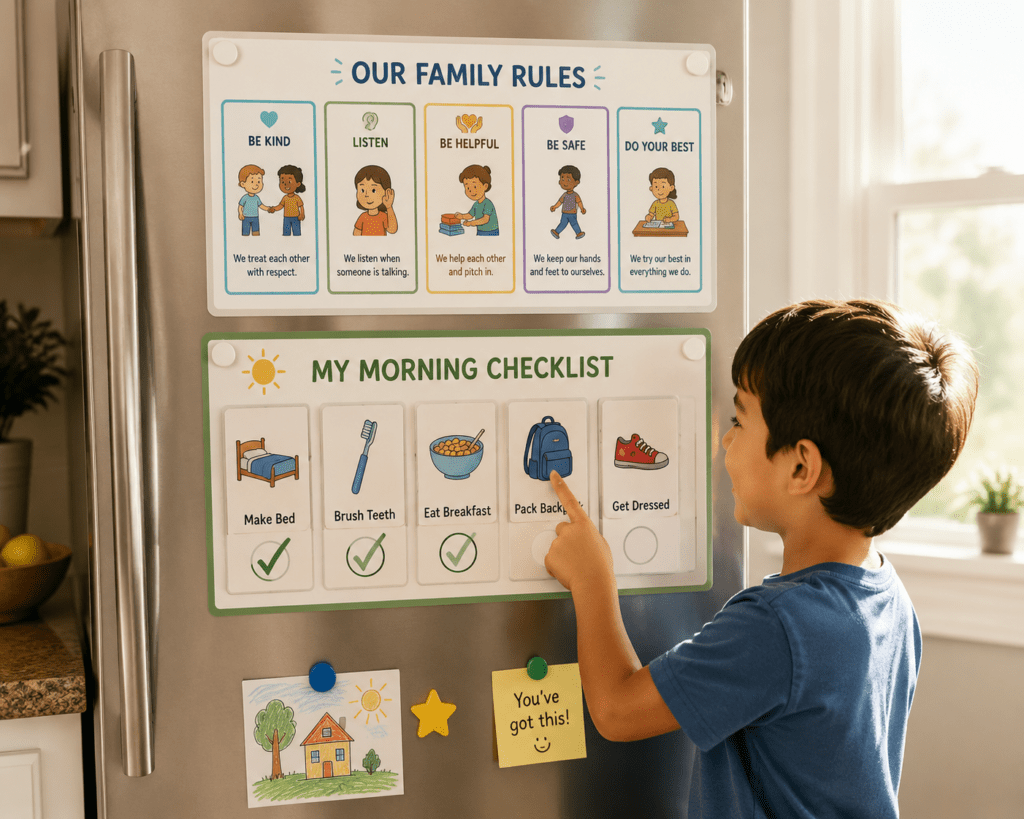
- Make rules visible. Post 3-5 family rules with pictures. Point instead of arguing.
- Build in movement. Physical activity before homework and after school reduces impulsive behavior for hours.
- Schedule daily special time. Ten minutes of child-led play, no corrections allowed. This single habit powers every other strategy, because kids cooperate for adults they feel connected to.
If your child does not listen the first time, drop the volume instead of raising it. Walk over, get eye level, and repeat once. An adhd kid does not listen the way other kids listen. Auditory processing differences are common, so closeness beats loudness every time.
Expert tip from our coaches: Put instructions in the room, not in your voice. A laminated morning checklist on the door replaces 15 daily reminders and removes you as the target of pushback.
ADHD Consequences: Teach Instead of Punish
Effective adhd consequences are immediate, short, logical, and delivered calmly. Kids with ADHD struggle to connect a Tuesday behavior to a Saturday punishment. Shrink the gap to seconds and the lesson lands.
- Natural consequences: let reality teach when safe. Refused a coat? A chilly walk teaches faster than a lecture.
- Logical consequences: tie the outcome to the act. Broke a toy in anger? Chores earn money toward the replacement.
- Privilege pauses: brief and same-day. “Screens are done for tonight” beats “no screens for a month,” which your child will experience as hopeless and you will fail to enforce.
- Time-out, done right: short (one minute per year of age), boring, and calm. Practice time-outs during happy moments so the real ones go smoothly. Pair every time-out culture with ten times more time-in, the connection which makes separation meaningful.
Warn once, follow through once, and skip the debate. Consistency, not severity, is what changes behavior in ADHD kids.
ADHD Positive Reinforcement: Build a Lasting Reward System
ADHD positive reinforcement works when rewards come fast, match effort, and change often. Research cited by CHADD shows reinforcement outperforms punishment for building new skills in kids with ADHD. Most home reward systems fail on speed and staleness, not on the idea.
Build yours in five steps:
- Pick one or two target behaviors, stated positively. “Hands to self.” “Started homework by 4:00.”
- Choose fast currency. Tokens, points, or marbles delivered within seconds.
- Set cheap, frequent payoffs. Small daily rewards beat a giant monthly prize an ADHD brain discounts to zero.
- Rotate rewards weekly. Novelty is fuel for a dopamine-seeking brain. Token fatigue kills charts by week three.
- Fade slowly. Once a behavior sticks, stretch the schedule and shift toward praise. Watch motivation as you fade, and slow down if behavior slips.
Avoid one common trap: threatening to remove earned rewards. CHADD notes the threat of losing a reward feels like punishment to a child with ADHD and drains their willingness to try. Earned means earned.
Hitting, Swearing, Spitting, Breaking Things: Scripts for the Hardest Moments
Aggressive behavior is a dysregulated nervous system, not a character flaw. Safety comes first, teaching comes later, and both need a plan. Here are the exact scripts we coach parents to use.
An adhd child hitting parents needs this sequence:
- Block and step back. “I won’t let you hit me.” Flat voice, no lecture.
- Reduce the audience. Big reactions feed the storm. Stay boring and safe.
- Offer the outlet. “You are allowed to be furious. Hit the cushion, stomp, or squeeze this.”
- Debrief later, once calm. “Your body got too angry for words. What would help next time?” Practice the plan when everyone is regulated.
For swearing: stay flat. Shock value is the payoff, so remove it. “Stop. Choose a different word.” Teach a replacement word and praise every use of it. If you want to stop an adhd child swearing at school, loop in the teacher on the exact same script so the response is identical everywhere.
For spitting: same flat response. “Spit goes in the sink. Wipe it up, then we reset.” Follow with a calm redo.
When your adhd child breaks everything mid-meltdown, prevention beats reaction. Create a rage-safe zone with pillows and stress balls, remove precious items during the storm season, and require age-fit repair afterward: help fix it, clean it, or contribute to replacing it. Repair builds accountability without shame.
A word on physical restraint: a safety hold is a crisis measure for imminent danger only, never a discipline tool. If holds are happening in your home, your family needs trained professional support. Programs teaching safe crisis response exist, and a child psychologist or behavior specialist will help you build a de-escalation plan so holds become unnecessary.
Expert tip from our coaches: After any aggressive episode, run a repair conversation within 24 hours. “We had a hard moment. I love you. Here is what we each do differently next time.” Rupture plus repair builds more resilience than a conflict-free home ever would.

How to Discipline a Child With ADHD and ODD
Discipline for ADHD and ODD together requires more connection, fewer commands, and rock-solid calm. Up to 40 percent of kids with ADHD also meet criteria for oppositional defiant disorder, according to the Child Mind Institute. Standard tips fall flat here, because a child with ODD experiences commands as threats and fights every one.
Adjust your approach in five ways:
- Cut commands by half. Every instruction is a possible battle. Save your authority for what matters.
- Offer two choices you accept. “Bath before or after the show?” Choice preserves their sense of control, the core ODD need.
- Never argue. State the limit once, then go quiet. Arguing is oxygen for oppositional behavior.
- Praise five times more than you correct. Defiant kids drown in negative attention. Flood the positive channel.
- Pick one behavior at a time. Ignore the eye-roll while you work on the hitting.
The same collaborative approach adapts well if you need to discipline a child with ODD alone, an autistic child, or a child with conduct disorder. In each case, reduce demands, increase predictability, and lean on professional guidance early. Conduct-level behaviors, cruelty, or zero remorse call for a full evaluation with a child psychologist, not a stricter home regime. We cover the ADHD-ODD combination in more depth in an upcoming guide.
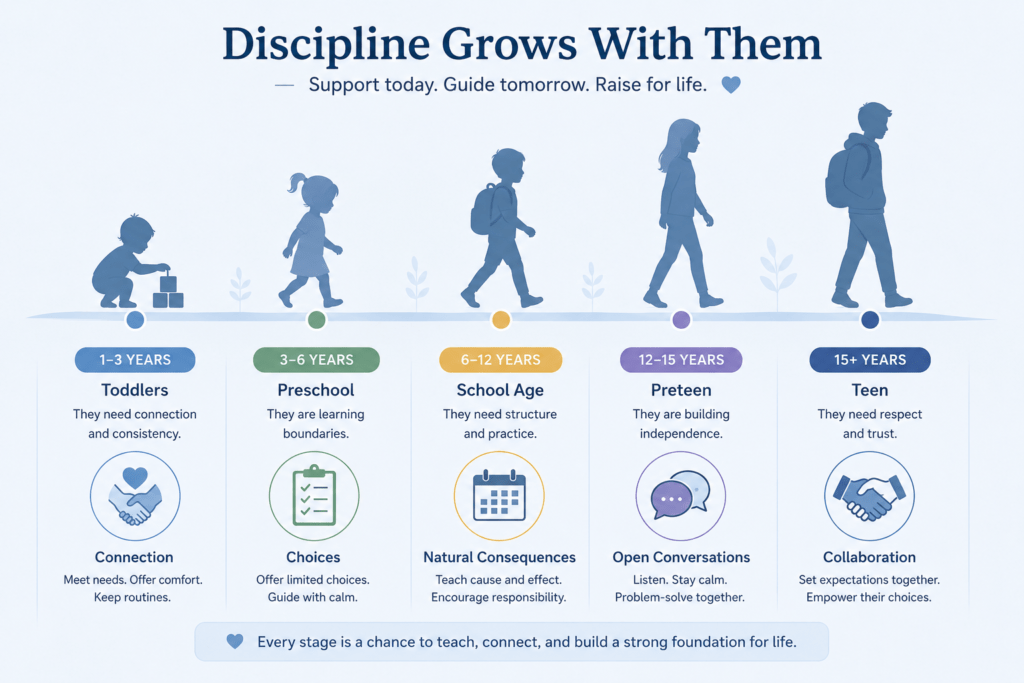
Discipline by Age: Toddlers to Teens
Match the method to the developmental stage, then subtract about three years for executive function. Here is the quick map.
| Age | What works | What to skip |
|---|---|---|
| Toddler with ADHD signs (2-3) | Redirection, environment design, naming feelings | Time-outs over 2 minutes, reasoning, any “diagnosis” pressure |
| How to discipline a 4 year old | Picture routines, 1-minute-per-year time-outs practiced in calm moments, instant praise | Multi-step commands, delayed rewards |
| 5 year olds with ADHD | Simple token systems, when-then language, movement breaks | Long explanations, removing recess-type outlets |
| ADHD symptoms in 7 year old boy (6-9) | CALM Anchor, visible rules, earned privileges, daily special time | Lectures, week-long groundings, comparing to siblings |
| Tweens (10-12) | Collaborative problem-solving, natural consequences, homework scaffolds | Public correction, sarcasm |
| Teens | Negotiated contracts, restored privileges for restored trust, coaching tone | Power struggles, surprise rule changes, phone seizure as first resort |
Two age-specific notes parents ask about. First, hyperactive behavior in a toddler is developmentally normal, so focus on structure rather than labels, and read our guide on whether it is ADHD or typical kid behavior. Second, teens with ADHD are wired for risk and novelty. Clear, pre-agreed consequences protect them better than reactive crackdowns.
What Not to Do With a Child With ADHD
Knowing what not to do with a child with adhd prevents most discipline disasters. Each item below reliably makes ADHD behavior worse.
- Yelling. Kids habituate fast and hear tone, not content. Yelling at an adhd child models the exact dysregulation you are trying to correct.
- Punishing symptoms. Fidgeting, forgetting, and blurting are neurology. Punishing them teaches shame, not skills.
- Long lectures. Attention checks out after the first sentence. Say less.
- Harsh or physical punishment. Decades of research, including the AAP’s guidance against corporal punishment, link it to more aggression, not less.
- Removing exercise as a consequence. Movement is medicine for ADHD brains. Never take recess, sports, or outside time.
- Demanding eye contact and stillness during correction. Let them fidget and pace. They hear you fine.
- Inconsistency. Enforcing a rule on Monday and ignoring it Tuesday teaches kids to gamble. Chaotic discipline confuses an ADHD brain more than any single bad moment.
- All-or-nothing punishment. “No screens for a month” collapses hope and motivation within a day.
Behavior Strategies for Students With ADHD at School
Behavior strategies for students with ADHD work best when home and school run the same playbook. Kids with ADHD are protected under Section 504 and, in some cases, IDEA, so schools must provide behavior support, not punishment alone.
- Request a 504 plan or evaluation in writing. Accommodations might include movement breaks, chunked assignments, preferential seating, and a quiet reset space.
- Replace lost-recess punishments. Ask the teacher to swap recess removal for a different consequence. Movement loss guarantees a worse afternoon.
- Share your home scripts. Give teachers your praise ratio, your warning language, and your swearing script so responses match.
- For the child who talks in class nonstop, ask for a private signal, scheduled share times, and a doodle-while-listening allowance. These channel the impulse instead of criminalizing it.
- Homework wars shrink with a body-double setup: parent nearby, timer running, work chunked into 10-minute sprints with movement between.
- Wondering about specialized settings? Most kids with ADHD thrive in regular classrooms with supports. A dedicated school for attention differences is worth exploring only after supports, therapy, and a strong behavior plan fall short.
When You Have No Patience Left: Regulate Yourself First
If you keep thinking, “I have no patience for my ADHD child,” your nervous system is depleted, not defective. Co-regulation is the engine of every strategy on this page, and it runs on your capacity. Refill it on purpose.
- Use the 3-breath rule before responding to any behavior.
- Step away when safe. “I need two minutes to calm my body” teaches regulation better than any lecture.
- Repair after you blow it. “I yelled. You did not deserve a yell. Let me try again.” One honest repair outweighs the rupture.
- Watch your own ADHD. The condition is highly heritable. A parent with untreated ADHD faces a much steeper climb to calm parenting, so consider your own evaluation.
- Get real support. Respite, a co-parenting agreement on rules, a parent group, or a coach. Depleted parents make punishing parents. Supported parents follow through.
Parent guilt deserves one direct word. The gap between the parent you want to be and the parent you were at 7:43 this morning is where growth happens, not where shame belongs. Guilt gets us nowhere. Learning gets us everywhere.
ADHD and Self-Discipline: Teach the Skill, Not the Fear
ADHD and self-discipline are skills problems, not a willpower problem, and skills grow with scaffolding. Your long-term goal is a young adult who manages their own brain. Build toward it in layers.
- Externalize everything first. Timers, checklists, alarms, and posted routines act as a borrowed prefrontal cortex.
- Shrink the step. “Open the math book” beats “do your homework.” Success on tiny steps builds the starting muscle.
- Teach studying discipline with sprints. Ten focused minutes, two movement minutes, repeat. Stamina grows over months.
- Hand over one system at a time. The child who runs their own morning checklist at 9 owns their study plan at 14.
- Narrate your own self-discipline out loud. “I want to skip the dishes. I will set a 10-minute timer and start.” Modeling beats commanding.
The same ladder helps older kids and adults who want to become more disciplined with ADHD: externalize, shrink, sprint, and build identity through small kept promises.
Lifestyle Changes for Managing ADHD in Children
Lifestyle changes for managing ADHD in children reduce the behaviors you would otherwise discipline. Think of these as antecedent moves, fixing the conditions before the storm forms.
- Sleep: most school-age kids need 9-12 hours. Even one short night measurably worsens impulsivity and emotional control.
- Movement: aim for 60 minutes daily. Exercise before homework improves focus for one to two hours afterward.
- Protein at breakfast: steadier attention through the morning.
- Screen boundaries: hard stops with timers and a warning, since screen-to-life transitions trigger more meltdowns than almost anything else.
- Outdoor time: time in green space is linked to reduced ADHD symptom severity in multiple studies.
None of these prevents ADHD. Nothing does, and no parenting style causes it. Lifestyle levers simply shrink the number of hard moments you and your child face each day.
When to Get Professional Help
Get professional help when aggression is frequent, school keeps calling, siblings live in fear, or you dread your own home. These signals mean your family needs more support, not more punishment. Effective options, alone or combined:
- Behavioral parent training. The American Academy of Pediatrics names parent training in behavior management the first-line treatment for children under six, ahead of medication.
- Parent coaching. Structured, skills-first support for applying everything on this page to your specific child. Learn what parent coaching involves and how it differs from therapy.
- Family coaching for whole-household patterns, sibling dynamics, and co-parenting alignment.
- Therapy for co-occurring anxiety, ODD, or trauma, and a conversation with a pediatrician or child psychiatrist about whether medication belongs in the plan. Well-timed treatment often makes every discipline strategy twice as effective.
If your child seems to need constant attention, melts down hourly, or shows a severe presentation none of the standard advice touches, please hear this: severe ADHD exists, it is not your fault, and families like yours are exactly who intensive supports were built for.
Myths vs Facts
- Myth: ADHD kids need stricter discipline. Fact: research shows harsher punishment worsens ADHD behavior over time.
- Myth: He behaves for video games, so he chooses to misbehave elsewhere. Fact: high-stimulation tasks recruit attention automatically. Boring tasks reveal the disability.
- Myth: Bad parenting causes ADHD. Fact: ADHD is a highly heritable neurobiological condition. Parenting shapes outcomes, not the condition itself.
- Myth: Medication replaces discipline. Fact: Treatment improves the brain’s ability to learn. Skills still need teaching.
- Myth: Rewards are bribes. Fact: A bribe stops bad behavior in the moment. A reward, planned in advance, reinforces a skill.
- Myth: She apologized, so she learned. Fact: ADHD kids often feel deep remorse and repeat the behavior anyway. Repetition is the disorder.
- Myth: Ignoring all misbehavior fixes it. Fact: Planned ignoring works only for attention-seeking behavior, paired with heavy praise elsewhere.
- Myth: Time-outs are outdated and harmful. Fact: brief, calm, practiced time-outs remain evidence-based within a warm relationship.
- Myth: Kids grow out of it, so wait. Fact: Symptoms persist into adulthood for the majority. Early skills change trajectories.
- Myth: Boys have ADHD, girls have attitude. Fact: girls are underdiagnosed because inattentive symptoms hide, and they receive discipline where they need support.
Common Mistakes Parents Make (and How to Avoid Them)
- Escalating severity when a consequence “fails.” Why it happens: desperation. The cost: hopeless kids stop trying. The fix: increase consistency and speed, never size.
- Debating the rule mid-enforcement. Why: kids with ADHD argue skillfully. The cost: every debate teaches that rules are negotiable. The fix: one sentence, then a broken-record repeat.
- Quitting a new system in week two. Why: pushback peaks right before change. The cost: kids learn outlasting you works. The fix: commit to three full weeks.
- Correcting every behavior at once. Why: everything feels urgent. The cost: constant criticism, zero progress. The fix: one target behavior at a time.
- Mismatched parents. Why: two philosophies in one house. The cost: kids exploit the gap, and anxiety rises. The fix: a written family plan both adults follow, even imperfectly.
Real Family Case Studies
Names and details changed. Patterns real.
Case 1: The 7-year-old who hit. Marcus hit his mom during transitions off screens. Punishments escalated for a year with zero change. We built a CALM plan: a 5-minute visual timer warning, a wall calendar of screen times, a crash-pillow corner, and instant praise for any peaceful power-down. Hitting dropped from daily to twice a month within six weeks. Lesson: the trigger was the transition, not the child.
Case 2: The 11-year-old with ADHD and ODD. Jaylen argued every instruction and had lost every privilege he owned, some through Christmas. His parents cut daily commands from about 40 to 15, offered two-choice options, and rebuilt privileges as same-day earnings. They banked five praises per correction. School suspensions stopped the following quarter. Lesson: fewer commands and restored hope beat a bigger hammer.
Case 3: The 5-year-old and the exhausted single mom. Riley’s mom messaged us, “I have no patience left.” We started with her, not Riley: a two-minute self-timeout ritual, one nightly repair sentence, and a Sunday respite swap with another parent. Then a simple marble jar with same-day payoffs for Riley. Mornings went from tears to tolerable in a month. Lesson: Parent regulation is step one, and support makes it possible.
Checklists
Beginner checklist (start this week):
- Pick one target behavior
- Post 3-5 visual family rules
- Start 10 minutes of daily special time
- Practice the 3-breath rule
- Praise 5 times for every correction
Advanced checklist (weeks 3-8):
- Run the full CALM Anchor sequence on every incident
- Build and rotate a token system
- Align school responses with home scripts
- Hold weekly co-parent plan reviews
- Add one repair conversation after every rupture
Quick reference for the heat of the moment:
- Breathe, drop your volume
- Connect and name the feeling
- One instruction, one warning
- Short logical consequence, zero debate
- Praise the turnaround, repair later
Print all three and put the quick-reference card on the fridge.
FAQ
How do you discipline a child with ADHD?
Connect before you correct, give one instruction at a time, and reinforce good behavior within seconds. Use short logical consequences instead of long punishments, keep rules visible, and stay consistent. Calm, immediate, predictable responses teach ADHD brains the skills punishment never builds.
Should you punish a child with ADHD?
Punishment is generally ineffective for ADHD and often backfires, according to research summarized by CHADD. Brief logical consequences have a place. Harsh, delayed, or shaming punishment increases defiance and damages self-esteem. Aim for a heavy ratio of reinforcement over correction.
How can I help my child with ADHD?
Build structure, praise effort immediately, protect sleep and daily movement, and work with the school on accommodations. Consider behavioral parent training or coaching, the first-line treatment recommended by the AAP for young children. Your calm, informed support is the single biggest factor in your child’s outcome.
How do I discipline a child with ADHD and ODD?
Cut commands in half, offer two acceptable choices, refuse to argue, and praise five times more than you correct. Target one behavior at a time. Because ODD feeds on power struggles, calm consistency plus professional support works far better than escalating punishment.
Why doesn’t my ADHD child respond to consequences?
ADHD brains under-respond to delayed feedback. A consequence delivered hours later, or lasting weeks, barely registers. Shrink the delay to seconds, keep the consequence short and logical, and pair it with fast reinforcement for the behavior you want instead.
How do I calm down an ADHD child during a meltdown?
Lower your voice, reduce words, and stay physically close but non-threatening. Name the feeling, offer a regulating outlet like deep pressure or movement, and wait. Teach and problem-solve only after the storm passes. A dysregulated brain is unable to process lessons.
How do I reduce impulsivity in my ADHD child?
Practice stop-and-think games in calm moments, use visual cues and timers, build daily exercise, and reinforce every caught impulse immediately. Impulsivity shrinks through thousands of tiny practiced pauses, supported where appropriate by treatment your pediatrician recommends.
Is it okay to yell at a child with ADHD?
Occasional human moments happen, and repair fixes them. As a strategy, yelling fails: kids habituate, hear tone instead of content, and mirror the dysregulation. Research links reduced yelling and harsh discipline to measurably better behavior in kids with ADHD.
What is a safety hold and should parents use one?
A safety hold is a physical crisis intervention for imminent danger, used by trained adults as an absolute last resort. It is never a discipline tool. If your home reaches this point, seek a professional de-escalation plan from a behavior specialist right away.
Does my son have ADHD or is he being a kid?
High energy, distraction, and impulsivity are normal in young children. ADHD is a question of degree, persistence across settings, and impairment. Our guide on telling the difference walks through the signs, and a pediatrician or psychologist provides a real evaluation.
Is it possible to prevent ADHD?
No parenting style prevents or causes ADHD. The condition is largely genetic. What you influence, powerfully, is trajectory: skills, self-esteem, family climate, and access to treatment. Early support changes outcomes even though it does not change neurology.
Do kids with ADHD need a special school?
Most thrive in regular classrooms with 504 accommodations, teacher partnership, and behavior support. Specialized programs help a minority with severe or complex presentations after standard supports fall short. Exhaust supports and treatment first, then evaluate placements with your team.
You Do Not Have to Figure This Out Alone
Every strategy on this page works better with a coach in your corner. At ParentCoaching.org, our certified parent coaches have supported families of kids with ADHD, ODD, autism, and anxiety for years, in Nashville and online nationwide, earning a 4.9-star rating from more than 200 parents. We will help you build a discipline plan matched to your child’s brain, your values, and your real life.
Book a private coaching session, join an online parenting class, or explore family coaching for whole-household change.
Your child is not broken. Your family is not beyond help. The right tools, used consistently, change everything.
This article offers educational guidance, not medical advice. For diagnosis and treatment decisions, consult your pediatrician, a child psychologist, or a child psychiatrist.