



Your child will not sit still. They forget shoes, backpacks, and homework after three reminders. They interrupt every conversation. A simple task turns into a meltdown. Some nights you wonder if something deeper is going on. Other nights you wonder if you are overreacting.
You are not alone, and you are not a bad parent for asking the question.
Most kids fidget, forget, and melt down sometimes. High energy, short attention, and big feelings come with growing up. So how do you tell when normal childhood behavior shades into something worth a closer look? The answer comes down to patterns, not single moments. This guide walks you through the difference, what else mimics ADHD, when to seek an evaluation, and the practical steps you take next.
Most children are forgetful, restless, and impulsive at times. ADHD becomes a concern when these behaviors are persistent, show up in more than one setting like home and school, feel stronger than expected for the child’s age, and interfere with learning, friendships, routines, safety, or self-esteem. Patterns over months matter more than rough days.
Key Takeaways
- Most kids are forgetful, restless, and impulsive sometimes. Pattern and impact separate normal behavior from ADHD.
- An ADHD pattern shows up most days, in more than one setting, stronger than peers the same age, for six months or longer.
- A child who locks onto video games but stalls on homework still fits the ADHD pattern. The reward gap explains it.
- Many other things mimic ADHD: poor sleep, anxiety, learning differences, autism, trauma, and being the youngest in the class.
- Book an evaluation when the pattern holds steady, crosses home and school, and hurts learning, friendships, or self-esteem. Start with your pediatrician.
- No single test diagnoses ADHD. Providers use DSM-5 criteria with parent and teacher input, rating scales, history, and screening across settings.
- Parent coaching does not diagnose. It builds routines, scripts, and systems to lower daily conflict alongside medical and school care.
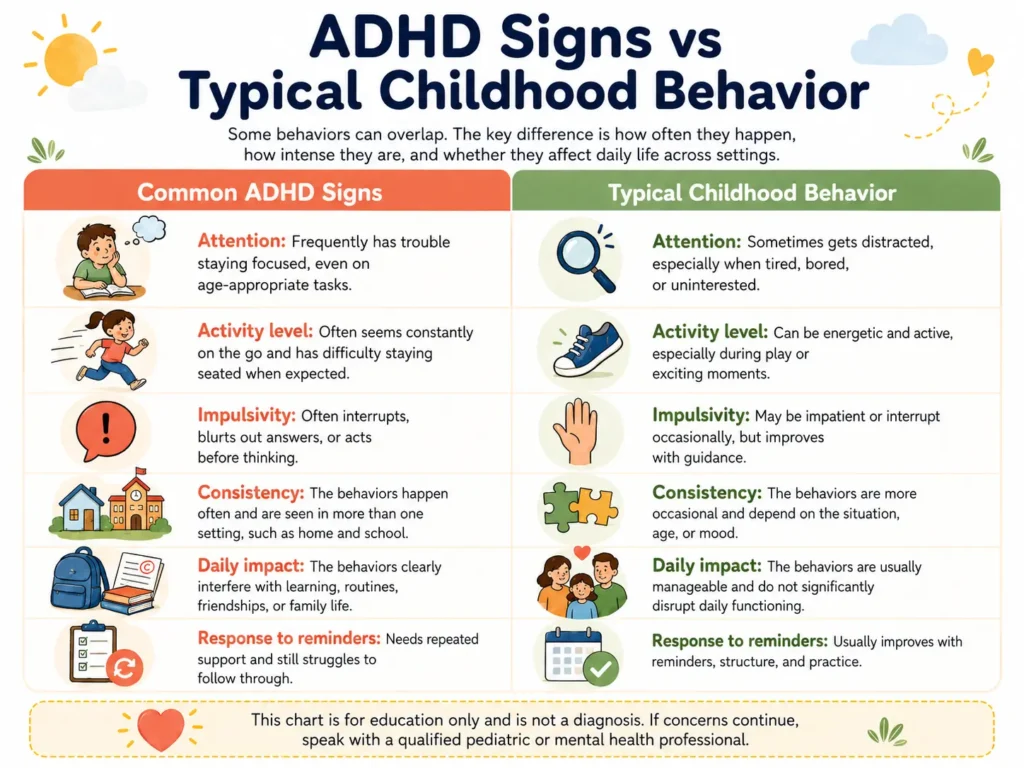
ADHD vs Typical Kid Behavior: What’s the Difference?
The clearest difference is pattern and impact. Typical kid behavior comes and goes, often tied to a reason. ADHD behavior holds steady across weeks, shows up in different places, and gets in the way of daily life.
| Dimension | Typical Kid Behavior | Possible ADHD Pattern |
|---|---|---|
| Frequency | Happens now and then, often tied to hunger, excitement, or a hard day | Happens most days, across many tasks and people |
| Intensity | Fits the moment and settles with comfort | Stronger than peers the same age, slow to settle |
| Duration | Passes within minutes, or after a snack or nap | Lasts six months or longer |
| Settings | Shows up mainly in one place, like a tough classroom | Shows up at home, school, and activities |
| Impact | Daily life keeps moving | Schoolwork, friendships, and routines suffer |
| Response to structure | Improves with clear routines and reminders | Struggles even with strong routines and reminders |
If you see the right-hand column most days, in more than one place, for months, the pattern deserves a professional look. One messy week does not.
Common ADHD Signs Parents Notice
Parents often spot three areas first: attention, activity level, and impulse control. Two more areas, emotions and planning, shape the hardest moments at home. Here is what each one looks like in real family life.
Inattention
Inattentive signs stay quiet and slip past adults, especially in girls. A child with inattentive ADHD looks dreamy and disorganized rather than disruptive.
- Forgets shoes, backpack, or homework even with reminders
- Loses the thread halfway through a simple chore
- Drifts off during conversations and instructions
- Makes careless mistakes on work they understand
- Focuses for hours on video games but stalls on homework
The video game gap confuses many parents. A fast game feeds the brain steady reward, so attention locks in. Homework offers no quick reward, so the same brain stalls. This pattern fits ADHD rather than ruling it out.
Hyperactivity
Hyperactive signs are loud and hard to miss. The child seems wired and in motion.
- Will not sit through a meal or a short task
- Climbs, runs, or fidgets at the wrong moments
- Talks almost nonstop
- Seems driven by an engine
Impulsivity
Impulsive signs show up as acting before thinking, even when the child knows better.
- Interrupts even when they know the rule
- Blurts answers before the question ends
- Struggles to wait for a turn
- Acts first and thinks after, sometimes around safety
Emotional Regulation
Big feelings hit fast and fade slow. Small setbacks land hard.
- Meltdowns spike during transitions
- Reacts bigger than the moment seems to call for
- Takes longer than peers to calm down
- Feels crushed by small corrections
Executive Function
Executive function is the brain’s planner. When it lags, multi-step tasks fall apart.
- Seems overwhelmed by multi-step tasks
- Starts a task and loses track of where they were
- Struggles to plan, organize, or watch the clock
- Forgets steps even after practice
What Looks Like ADHD But Often Is Not
Many other things copy ADHD signs. A good evaluation rules these out first, because treating the wrong cause leaves your child struggling. Here are the common look-alikes.
- Poor sleep or sleep apnea: a tired brain looks restless and unfocused
- Anxiety: a worried mind drifts, fidgets, and avoids hard tasks
- Depression or low mood: low energy and weak focus read as inattention
- Learning differences: reading or math struggles look like avoidance
- Autism or sensory processing needs: overwhelm and routine struggles overlap with ADHD
- Trauma or major stress: a stressed child stays on high alert and distracted
- Vision or hearing problems: a child who does not see or hear well tunes out
- Giftedness or boredom: an under-challenged child checks out in class
- Age-related immaturity: research shows the youngest children in a grade get diagnosed far more often, simply because they are younger than classmates
- Screen overstimulation: heavy fast media shortens patience for slow tasks
- Inconsistent routines: a shifting schedule leaves any child scattered
This is the part most quick online checklists skip. ADHD is one possibility among several. A careful provider weighs all of them.
When to Ask for an ADHD Evaluation
Book an evaluation when the pattern holds steady, shows up in more than one setting, and gets in the way of daily life. You do not need a diagnosis to ask for help. Use this checklist.
- Teachers raise the same concerns more than once
- Homework or routines cause daily conflict
- Your child is losing friends or playdates
- Safety problems show up from impulse
- Your child feels ashamed, anxious, or “bad”
- Symptoms appear at home and at school
- Normal parenting strategies stop working
Start with your pediatrician. They evaluate, screen for other causes, and refer when needed. A child psychologist or child psychiatrist handles deeper assessment. The American Academy of Pediatrics recommends evaluation for children ages 4 to 18 who show academic or behavioral problems alongside inattention, hyperactivity, or impulsivity.

What Happens During an ADHD Evaluation
There is no single ADHD test. A provider gathers information from several sources and checks symptoms across settings and time. A typical evaluation includes seven steps.
- Parent input about behavior at home
- Teacher or school input about behavior in class
- Standardized rating scales for both settings
- A full developmental history from early childhood
- Medical history and a physical check
- Screening for sleep, anxiety, mood, learning, vision, and hearing
- A review of symptoms in more than one setting, lasting six months or longer
Providers use DSM-5 criteria. They look for six or more symptoms in children, present for at least six months, showing before age twelve, and strong enough to disrupt daily life. No brain scan or blood test diagnoses ADHD.
Note: Parent coaching supports families with routines, scripts, and daily strategies. It does not replace a medical or psychological evaluation.
What Parents Can Do This Week
You do not have to wait for a diagnosis to bring calm home. Small changes ease daily friction and give your doctor better information later. Start here.
- Keep a simple behavior log with the date, the trigger, and what helped
- Ask the teacher for specific examples, not labels
- Protect sleep with a steady bedtime and a screen cutoff
- Use short, clear, one-step instructions
- Break tasks into small steps with a visible finish line
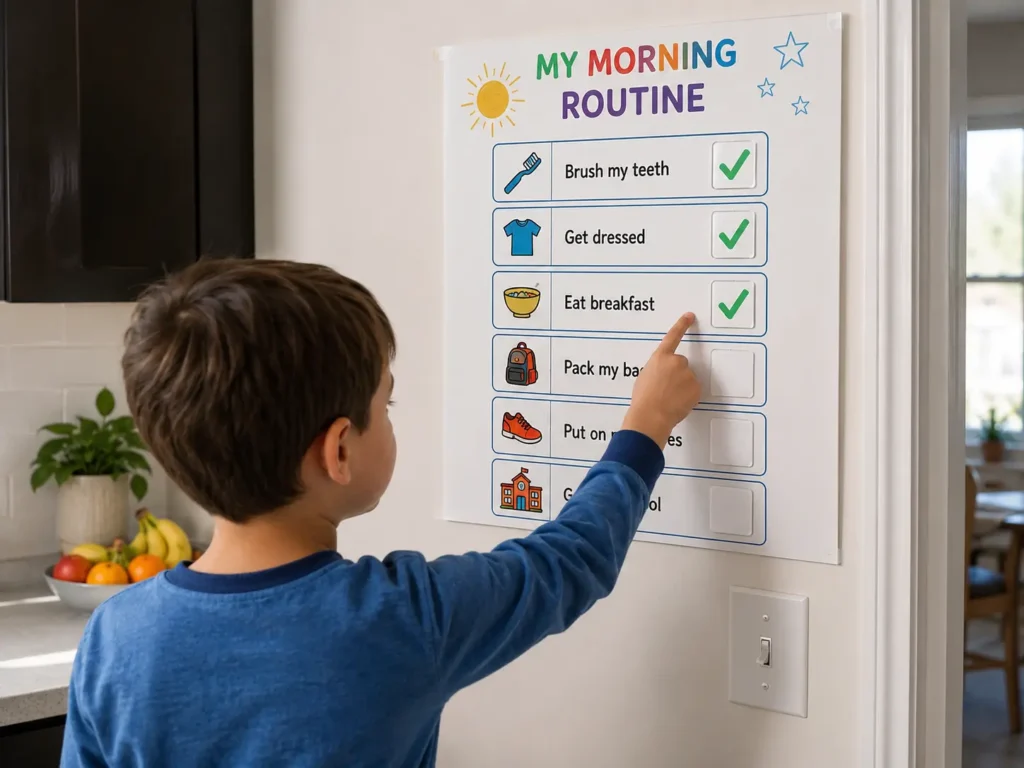
- Post a visual routine for mornings and homework
- Praise effort and progress out loud
- Drop labels like lazy, bad, or defiant
- Watch for triggers before the hard moments hit
- Reach out for support when the pattern strains family life
These steps lower the temperature at home whether or not the answer turns out to be ADHD.
How ParentCoaching.org Helps
A diagnosis answers the what. Daily life answers the how. This is where parent coaching fits.
ParentCoaching.org works with parents of children and teens facing ADHD, autism, anxiety, ODD, sensory needs, and tough behavior. We coach you, the parent. We do not diagnose your child, and we work alongside your pediatrician, school, and therapist. Need the whole household on the same page? Our family coaching brings both parents into one plan.
Together we build:
- Morning routines that lower the daily battle
- Homework systems with clear steps and built-in rewards
- Transition plans for the hardest moments of the day
- Emotional regulation scripts you use in the moment
- Co-parenting consistency across two homes
- School communication plans for teachers, 504 plans, and IEPs
- Practical strategies for ADHD, autism, anxiety, sensory needs, and defiance
We coach families in Nashville and online across the country. If the daily struggle is wearing you down, you do not have to figure it out alone.
Ready for a calmer week? Book a free parent coaching consultation and walk away with one strategy you use the same day. Want to start small? Explore our online parenting classes, or read our guide to parenting a child with ADHD.

Frequently Asked Questions
How do I know if my child has ADHD or is energetic?
Look at patterns and impact, not single moments. An energetic child settles with structure and keeps daily life moving. An ADHD pattern holds for months, shows up at home and school, and gets in the way of learning, friendships, and routines.
At what age do ADHD evaluations start?
The American Academy of Pediatrics supports evaluation from age 4 through 18. Diagnosis in 4 to 6-year-olds takes extra care, because young children are restless and impulsive by nature. Many providers start with parent behavior training before naming a diagnosis at that age.
Do some kids mask ADHD at school?
Yes. Some children hold it together all day at school, then fall apart at home, where they feel safe. Others struggle most in the classroom. Symptoms in either place still count, which is why providers gather reports from home and school.
Do sleep problems look like ADHD?
Yes. A tired brain looks restless, distracted, and irritable. Sleep apnea, late bedtimes, and broken sleep all mimic ADHD signs. Any good evaluation screens for sleep before settling on a diagnosis.
Does anxiety look like ADHD in children?
Often. A worried mind drifts, fidgets, avoids hard work, and struggles to focus. Anxiety and ADHD also show up together. A provider sorts out which one drives the behavior, or whether both do.
Should I ask my child’s teacher about ADHD signs?
Yes. Teachers see your child against dozens of same-age peers all day. Ask for specific examples, like “stands up six times during reading,” rather than the word ADHD. Those details help any future evaluation.
What should I track before talking to a doctor?
Keep a two-week log. Note the date, the situation, the behavior, how long it lasted, and what helped. Add teacher comments and sleep patterns. Concrete examples beat general worry and speed up the visit.
Does parent coaching diagnose ADHD?
No. Parent coaching does not diagnose or treat medical conditions. A coach helps you build routines, scripts, and daily systems, and works alongside the professionals who handle diagnosis and treatment.
How does parent coaching help a child with ADHD?
Coaching changes the daily environment around the child. Clear routines, short instructions, visual schedules, and calm scripts lower conflict and build your child’s confidence. These supports work well next to medical or school care.
When should I book a consultation?
Book when daily routines feel like a battle, when school keeps raising concerns, or when you feel stretched thin. You do not need a diagnosis first. Coaching helps while you wait on an evaluation, and after one, too. Book a free consultation to start.
About the Author
Certified Parent Coach at ParentCoaching.org has spent 15+ years helping families of neurodivergent children build calmer homes. coaches parents of children with ADHD, autism, anxiety, ODD, and sensory needs in Nashville and online nationwide.
Educational Disclaimer
This article is for education and support only. It cannot diagnose ADHD or any condition, and it does not replace medical or psychological advice. Only a qualified healthcare provider diagnoses ADHD. A provider can also discuss treatment options, including behavior therapy and, when appropriate, medication. If you have concerns about your child, speak with your pediatrician or a licensed professional.