



An ADHD morning routine works best when it starts the night before, follows the same order every day, and relies on visual supports instead of repeated verbal reminders. Lay out clothes and backpacks in the evening, wake your child with light and connection, follow a picture checklist, and serve a protein-rich breakfast. Consistency beats perfection.
If your mornings involve four wake-up attempts, a meltdown over socks, and a sprint to the car, you are in good company. The CDC reports 11.4 percent of US children, about 1 in 9, have been diagnosed with ADHD. Millions of families fight the same 7 a.m. battle. This adhd morning routine guide gives you a complete system, from wake-up science to a printable checklist, plus adaptations for parents who have ADHD themselves.
Key takeaways
- Mornings are won or lost the night before, so move every possible decision to the evening.
- Visual checklists and adhd routine charts outperform verbal reminders because they offload working memory.
- Connection lowers resistance faster than correction, especially in the first ten minutes after waking.
- Expect the routine to wobble. Refresh it every few weeks instead of abandoning it.
Why Are Mornings So Hard for Kids With ADHD?
Mornings feel hard because they demand planning, sequencing, time awareness, and emotional control before the brain is fully awake. Children with ADHD run about 30 percent behind peers in these executive skills, according to research popularized by Dr. Russell Barkley. The struggle is neurological, not defiance or laziness.
Think about what “get ready for school” requires. Your child must wake on cue, resist distraction, sequence eight or more tasks, track invisible time, tolerate sensory input like bright lights and scratchy tags, and regulate frustration, all under a hard deadline. Each demand taps executive function, the brain’s management system. Dr. Philip Shaw’s NIH research found attention-related brain regions in children with ADHD mature roughly three years later than in peers. Your 9-year-old is running a 6-year-old’s operating system through the most demanding hour of the day.
Sleep stacks the deck further. Research in Nature and Science of Sleep found sleep problems in roughly 73 percent of children with ADHD, compared with 20 to 30 percent of children overall. A short night shrinks the executive fuel tank before the alarm even rings. Parents who search for adhd difficulty waking up in the morning are usually looking at a sleep problem with a behavioral cost.
Coach’s tip: reframe the morning as an executive function obstacle course, not a character test. The moment you stop reading resistance as disrespect, your tone changes, and your child’s nervous system follows yours.
Do People With ADHD Struggle With Routine?
Yes. Most people with ADHD struggle with routine because the ADHD brain craves novelty and resists repetition. Routines still help enormously, though. The goal is an adhd friendly routine built on external supports, flexibility, and quick rewards rather than willpower. Structure succeeds when it fits the brain it serves.
Here is the paradox at the heart of adhd and routine: the brains most helped by structure are the brains most likely to resist it. A rigid adhd schedule collapses within weeks because sameness drains motivation. A flexible one survives because it leaves room for novelty. So rotate breakfast options within a fixed breakfast time. Swap the wake-up playlist monthly. Keep the sequence stable and let the details breathe. This is how adhd and schedules learn to coexist. Questions about adhd and routines come up in nearly every coaching call we take, and the same pattern holds across the whole day, not only mornings. Build adhd friendly routines around anchors, not minute-by-minute scripts. The strongest adhd routines share three traits: external, rewarding, and easy to refresh.
If you have wondered how to make a routine with adhd stick, the answer sits in three words: externalize, reward, refresh. Externalize the steps onto a chart. Reward completion quickly. Refresh the format before boredom kills it.
The LAUNCH Method: A 6-Step ADHD Morning Framework
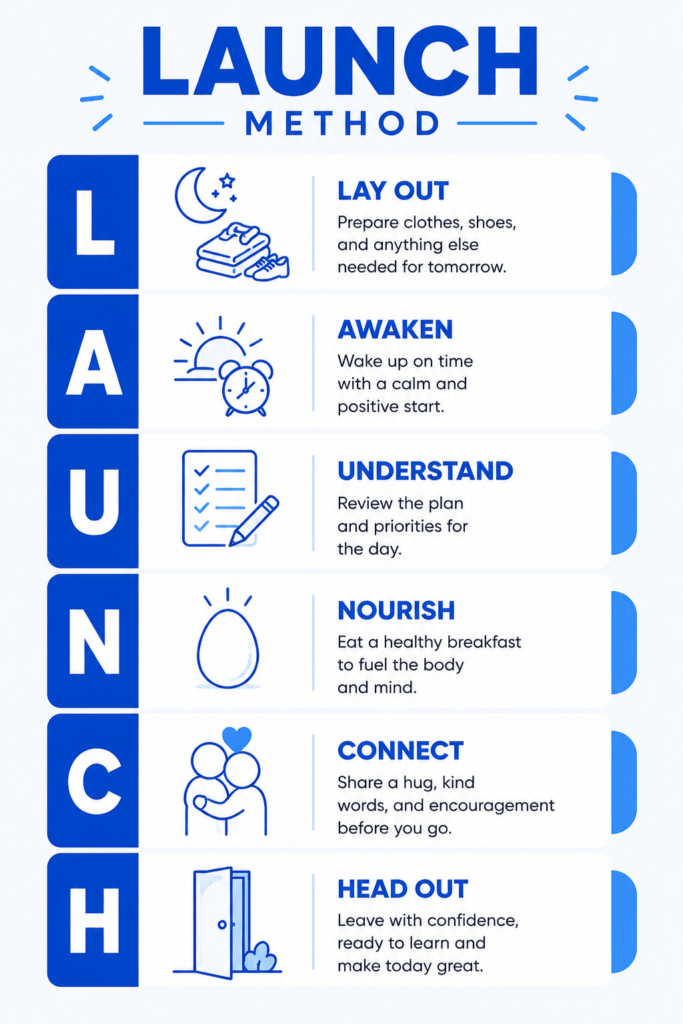
Most adhd morning routine tips fail because they target the child’s behavior instead of the system around it. The LAUNCH Method fixes the system. It is our six-step framework for calmer ADHD mornings: Lay it out tonight, Anchor the wake-up, Use a visual checklist, Nourish with protein, Connect before you correct, and Head out from a launch pad. Each step removes one executive function demand from the most fragile hour of the day.
- L. Lay it out tonight. Clothes chosen, backpack packed, lunch made, shoes by the door. Evening brains have more fuel than morning brains, so make decisions when they cost less.
- A. Anchor the wake-up. Same time daily, weekends included when possible. Pair a light cue with a sound cue, then add a physical anchor like opening the curtains together.
- U. Use a visual checklist. Post the sequence where your child gets ready. Pictures for young kids, words for older ones. The chart does the nagging, so you never have to.
- N. Nourish with protein. Eggs, yogurt, a smoothie, or nut butter toast steadies blood sugar and supports focus through the school morning. Skip the sugar spike.
- C. Connect before you correct. Two minutes of warmth, a hug, a joke, a snuggle, buys twenty minutes of cooperation. Narrate the next step instead of criticizing the last one.
- H. Head out from a launch pad. One spot by the door holds everything: backpack, shoes, jacket, and signed forms. Nothing leaves the house from anywhere else.
Coach’s tip: introduce one letter per week. Families who install all six steps at once burn out by day ten. Families who stack them slowly still run the system a year later.
A Sample Morning Schedule for Kids With ADHD
This sample morning schedule for kids with ADHD runs 60 minutes from wake-up to walk-out, with a 10-minute buffer built in. Adjust the times to your school start, but keep the order identical every day. Sequence stability, not clock precision, is what builds automaticity.
| Time | Step | Support |
|---|---|---|
| 6:45 | Wake with light + music cue | Curtains open, upbeat playlist, gentle touch |
| 6:50 | Warm-up window | Stretch, sip water, pet the dog, no screens |
| 7:00 | Bathroom + get dressed | Clothes already laid out, visual timer running |
| 7:15 | Protein breakfast | Two rotating options, chosen the night before |
| 7:30 | Teeth, hair, meds if prescribed | Picture checklist on the bathroom mirror |
| 7:40 | Launch pad check | Backpack, shoes, jacket, forms, one final scan |
| 7:45 | Out the door | Five-minute cushion for the inevitable surprise |
Movement helps almost every child in this population. Ten jumping jacks between breakfast and teeth, or a race to the mailbox, raises dopamine and norepinephrine and burns restless energy before the classroom asks for stillness. A calm launch also shapes the whole class morning, and teachers usually notice the difference within two or three weeks.
ADHD Morning Routine Checklist (Printable)
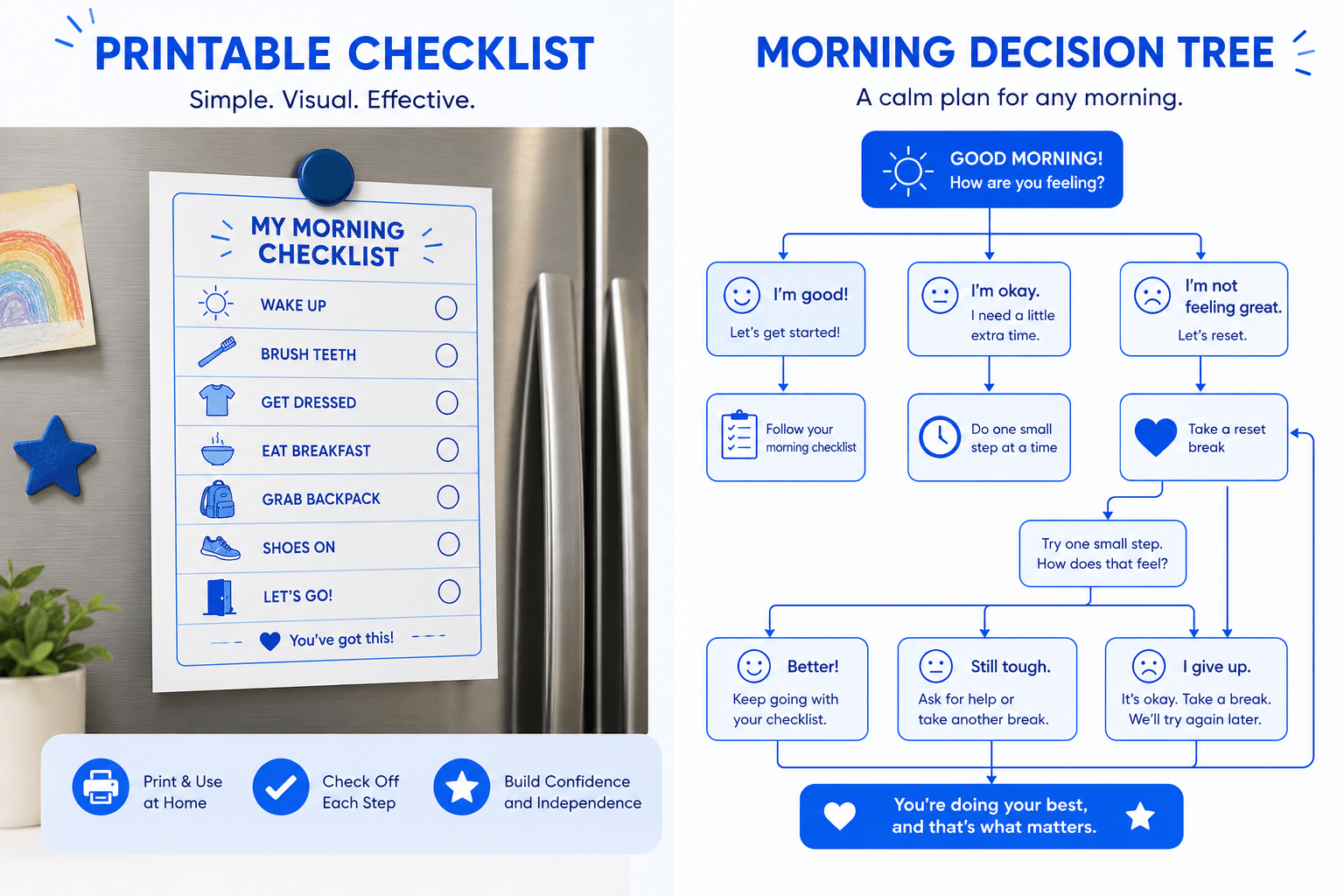
Use this adhd morning routine checklist as a starting template, then trim it to the six or eight steps your child needs most. Laminate it or slide it into a page protector, post it at eye level, and let your child check off each item with a dry-erase marker.
Night before
- Lay out tomorrow’s clothes, socks, and shoes included
- Pack the backpack and place it on the launch pad
- Make lunch or stage the ingredients
- Confirm the alarm is set and placed across the room
- Screens off an hour before bed
Morning
- Out of bed by the second cue
- Bathroom and dressed before leaving the bedroom zone
- Protein breakfast eaten or packed
- Teeth brushed, hair done, medication taken if prescribed
- Launch pad scan: backpack, shoes, jacket, water bottle
- Out the door with five minutes to spare
Checking a box delivers a small dopamine hit, which is exactly the fuel an ADHD brain runs on. Extend the same format into a full adhd daily routine checklist by adding after-school and bedtime blocks, and you have covered the adhd daily cycle end to end.
ADHD Routine Charts: Making the Sequence Visible
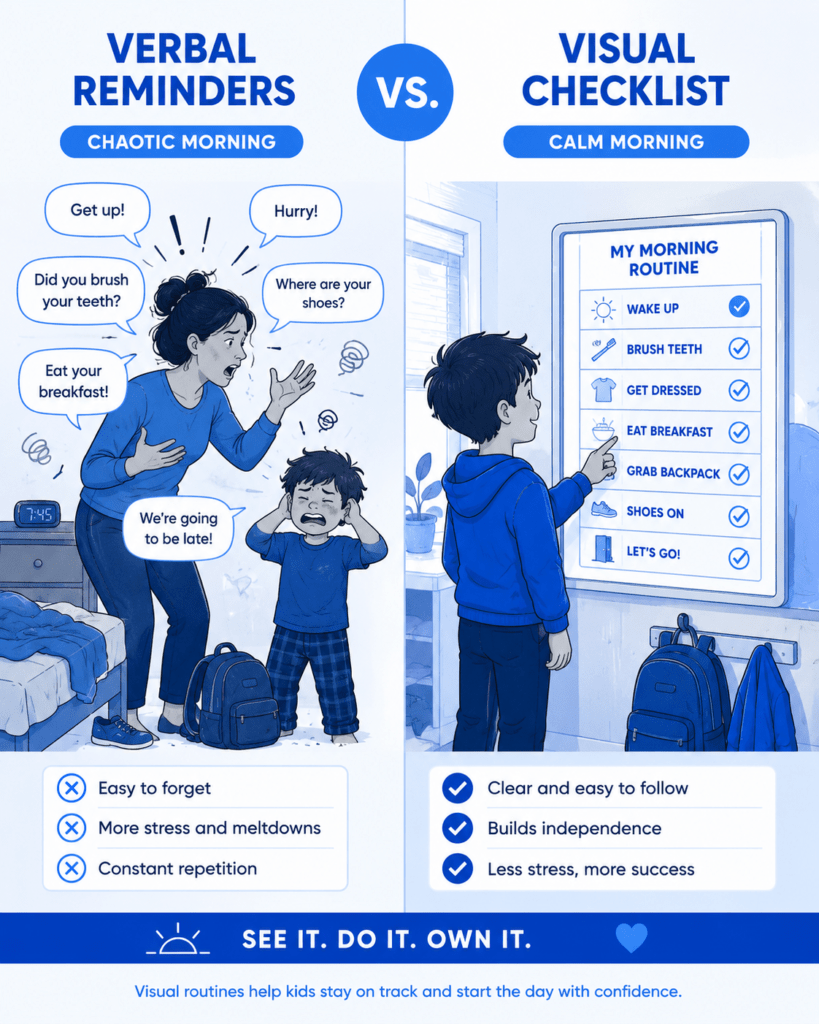
ADHD routine charts turn an invisible sequence into something your child sees, touches, and completes without your voice in the loop. The right format depends on age. Pictures work for preschoolers, picture-plus-word charts for early elementary, written checklists for tweens, and apps for teens and adults.
| Age | Chart format | Placement |
|---|---|---|
| 3-5 | Photo or icon cards, 4-5 steps | Bedroom door, child height |
| 6-9 | Pictures with words, 6-8 steps, dry-erase checkboxes | Bathroom mirror |
| 10-13 | Written checklist or magnetic board | Bedroom + kitchen |
| Teens | Phone checklist app or whiteboard | Wherever they get ready |
An adhd daily routine chart earns its keep when your child consults it without prompting, which usually takes two to four weeks of you pointing at it instead of repeating instructions. Point, smile, walk away. The chart becomes the boss, and you get to stay the parent.
ADHD Morning Routine Flow Chart: What to Do When Steps Fail
An adhd morning routine flow chart gives you a pre-decided response for each common breakdown, which keeps you calm because the decision was made on a good day, not in the heat of a bad one. Follow the branch, skip the argument.
- Child not out of bed after two cues → open curtains fully, start the playlist, offer a piggyback ride to the bathroom. Still down after five more minutes → move breakfast to a grab-and-go and protect the leave time.
- Stuck mid-task, distracted → point silently at the chart, name the next step once, start the visual timer.
- Meltdown over clothing or sensory input → drop the timeline talk, co-regulate first, offer the backup outfit chosen last night.
- Refusing breakfast → send the protein option in the car or backpack. Fuel matters more than the table.
- Running late anyway → skip optional steps in a pre-agreed order (hair before bed-making, never breakfast or meds) and review the night-before list after school, without blame.
| Situation | Recommended action | Avoid |
|---|---|---|
| Slow wake-up | Light, sound, movement, in this order | Ripping off blankets, yelling from another room |
| Ignored chart | Point and name the step once | Repeating instructions five times |
| Sensory meltdown | Co-regulate, backup outfit | Reasoning mid-meltdown, punishing the outburst |
| Chronic lateness | Add buffer, subtract steps | Adding lectures, adding steps |
ADHD Wake-Up Battles: Fixing the Hardest Ten Minutes
Most adhd wake up battles trace back to short sleep, a delayed body clock, and jarring alarms, not stubbornness. Fix the evening first, then soften the wake-up with light, sound layered in steps, and a reason to get vertical. The morning starts the night before, biologically and practically.
Many kids with ADHD fall asleep late, no matter the bedtime, because their circadian rhythm runs delayed. Protect sleep with a consistent lights-out, screens off an hour prior, and a cool, dark room. In the morning, flood the room with light immediately, since bright light is the strongest wake signal the brain accepts. Layer cues: a soft alarm, then music, then a parent’s touch. Place the alarm across the room so turning it off requires standing. Finally, give the wake-up a magnet, a favorite breakfast, five minutes of a comic book, or the dog waiting for a cuddle. Getting up for something beats getting up because of someone.
If your child seems impossible to rouse every single day despite solid sleep hygiene, mention it to your pediatrician. Sleep disorders travel with ADHD often enough to be worth ruling out.
ADHD, Mood, and the Rest of the Picture
ADHD rarely travels alone. CDC data show nearly 78 percent of children with ADHD have at least one co-occurring condition, and about 4 in 10 live with anxiety. Searches for ADD and mood disorders keep climbing for good reason: attention challenges and emotional health overlap constantly, and mornings expose the overlap.
Anxiety turns a normal morning into a threat scan. Low mood turns the blanket into a weighted anchor. If your child’s morning resistance comes with worry talk, tears, frequent stomachaches, or school refusal, the routine alone is not the whole answer. Bring the pattern to your pediatrician or a child therapist. A good adhd routine reduces friction, and treatment addresses what friction was hiding.
This guide offers educational information, not medical advice. Decisions about diagnosis, therapy, or medication belong with your child’s healthcare providers.
Morning Routines for Parents Who Have ADHD Too
ADHD runs in families, so many parents managing a child’s morning are managing their own executive function at the same time. The fix is the same system, scaled up: an adhd daily checklist for adults, night-before prep, and a wake-up anchored to light and movement rather than willpower.
ADHD morning behavior adults describe most often includes snooze loops, doom scrolling in bed, and losing twenty minutes to a side quest like reorganizing a drawer. Sound familiar? Run your own LAUNCH sequence. Lay out your clothes next to your child’s. Put your phone across the room with the alarm. Build a two-column chart, yours and theirs, because adhd routine charts for adults work on the same dopamine principle as kids’ charts. Keep your own adhd daily checklist to five items maximum and stage your keys, wallet, and bag on the family launch pad.
A day in the life of someone with adhd often swings between chaos and hyperfocus, and mornings set the swing in motion. Morning routines for adhd adults are not about becoming a productivity influencer. They are about spending your limited executive fuel on your kids instead of on hunting for your keys.
Common ADHD Morning Routine Mistakes and How to Fix Them
The most common mistakes are building the routine too big, relying on verbal reminders, treating slip-ups as defiance, and quitting when novelty fades. Each mistake has a simple fix: shrink the routine, externalize it, depersonalize the struggle, and refresh the format instead of abandoning it.
- Too many steps at once. Why it happens: Desperation breeds ambition. Consequence: collapse by week two. Fix: start with three steps, add one per week.
- Nagging is the delivery system. Why: it feels faster. Consequence: your voice becomes background noise and conflict fuel. Fix: point at the chart, narrate the next step once.
- Punishing morning failures. Why: Lateness feels like disrespect. Consequence: shame spikes, cooperation drops, self-esteem erodes. Fix: praise partial wins, problem-solve after school.
- Abandoning the routine when it gets boring. Why: novelty fades for kids and parents alike. Consequence: back to chaos. Fix: same sequence, new format, new playlist, new marker color.
- Weekend free-for-alls. Why: everyone deserves a break. Consequence: Monday resets to zero. Fix: keep wake time within an hour of the school schedule and run a lighter version of the checklist.
ADHD Morning Routine Myths vs Facts
- Myth: My child would get up if the consequences were tougher. Fact: wake-up struggles reflect sleep biology and executive delay, and punishment adds cortisol without adding skill.
- Myth: kids with ADHD hate all structure. Fact: they resist rigid structure and thrive with flexible, visual, reward-rich structure.
- Myth: A routine chart is babyish for a 12-year-old. Fact: format matters, not the concept. Adults use checklists to fly planes.
- Myth: One bad morning means the system failed. Fact: trend beats episode. Score the week, not the day.
- Myth: My child ignores the chart, so charts are useless. Fact: charts need two to four weeks of pointing-not-nagging before they stand alone.
- Myth: Breakfast is optional if we are late. Fact: blood sugar drives attention and mood until lunch. Pack it to go instead.
- Myth: screens help my child wake up. Fact: screens hijack the getting-ready sequence more reliably than any other trigger.
- Myth: the goal is a perfect morning. Fact: the goal is a repeatable morning with less conflict than last month.
- Myth: only the child needs the routine. Fact: your regulation sets the ceiling for theirs, and many parents share the diagnosis.
- Myth: Routines cure ADHD. Fact: routines reduce friction. Diagnosis, therapy, coaching, and sometimes medication address the rest, guided by professionals.
Real Families, Real Mornings: Three Case Studies
These composites reflect patterns from families we coach, with details changed for privacy.
Case 1: the 7-year-old who ignored every instruction. Problem: Maya’s mom repeated each step five or six times, and mornings ended in tears twice a week. Solution: a five-picture chart on the bathroom mirror, point-and-smile instead of repeat-and-plead, a sticker for beating the timer. Outcome: independent completion of four of five steps within three weeks, tears down to twice a month. Lesson: the chart replaced the nagging, and removing the nagging removed most of the conflict.
Case 2: the 11-year-old who slept through everything. Problem: Deshawn needed 25 minutes and three parents’ worth of effort to wake. Solution: screens out of the bedroom, bedtime moved 45 minutes earlier over two weeks, sunrise-style lamp plus a music alarm across the room, waffles as the Friday magnet. Outcome: up by the second cue most days within a month. Lesson: the wake-up problem was a sleep problem in disguise.
Case 3: the mom with ADHD parenting two kids with ADHD. Problem: Jenna ran out of executive fuel before her kids finished breakfast. Solution: a family launch pad, a two-column chart, her own five-item adhd daily checklist, and coaching sessions to script the hard moments. Outcome: on-time departures went from two mornings a week to four, and yelling dropped enough for her daughter to comment on it. Lesson: parent systems and child systems rise together.
When to Get Help, and How Parent Coaching Fits
Get outside help when mornings stay combative after four to six weeks of consistent routine work, when wake-up struggles persist despite solid sleep habits, or when anxiety, low mood, or school refusal enters the picture. Pediatricians rule out medical causes. Parent coaches build the daily system with you.
Knowledge rarely fails parents. Implementation under stress does. At Parent Coaching, our certified coaches have guided hundreds of families raising kids with ADHD, autism, and anxiety, and parents rate the experience 4.9 stars across more than 200 reviews. We work with Nashville families in person and with families nationwide online. Together, we build your morning system, script the hard moments, and adjust week by week until calm becomes the default.
Ready for mornings without the battle? Book a free consultation, or email info@parentcoaching.org. One conversation now beats another year of chaotic 7 a.m. starts.
FAQ: ADHD Morning Routine Questions Parents Ask
What time should a child with ADHD wake up?
Work backward from departure. Most kids need 60 to 75 minutes to move through wake-up, dressing, breakfast, and hygiene without rushing. Keep the wake time consistent every day, weekends within an hour, so the body clock stays anchored and Monday stops feeling like jet lag.
How long should an ADHD morning routine take?
Aim for 60 minutes with a built-in 10-minute buffer. Shorter windows create pressure that the ADHD brain converts into shutdown or conflict. Longer windows invite drift and distraction. If your current routine takes 90 minutes of struggle, shrink the step count before you shrink the clock.
Why is waking up so hard for kids with ADHD?
Three forces stack: sleep problems affect roughly 73 percent of children with ADHD, their body clocks often run delayed, and executive function is weakest in the first minutes after waking. Light exposure, layered gentle cues, and a motivating first activity address all three.
My child ignores the routine chart. Now what?
Charts fail when they compete with a parent’s voice. For two weeks, point at the chart instead of speaking the reminder, then praise each completed step. Refresh the format monthly, new pictures, new marker, new location, because novelty keeps the ADHD brain engaged with familiar structure.
Should ADHD medication come before or after breakfast?
Timing depends on the specific medication and your child’s appetite pattern, so ask your prescriber. Many families give stimulants with or right after breakfast so food lands before appetite dips. Never adjust timing or dosage without professional guidance.
How do I make a routine with ADHD stick long-term?
Externalize, reward, refresh. Put the steps on a visible chart, attach quick rewards like checkboxes and praise, and change the format before boredom sets in. Expect a dip around week three, plan the refresh, and score weekly trends rather than daily performance.
What breakfast helps kids with ADHD focus?
Protein-forward options: eggs, Greek yogurt, smoothies with nut butter, or cheese and whole-grain toast. Protein steadies blood sugar and supports the neurotransmitters that attention runs on. Rotate two or three pre-approved choices, decided the night before, to remove the morning negotiation.
Do weekends need the same ADHD schedule?
Keep wake and sleep times within an hour of school days and run a lighter version of the checklist. Full weekend free-for-alls delay the body clock and reset habit gains, which is why Mondays collapse. Structure the anchors, relax everything in between.
Do adults with ADHD need a morning routine too?
Yes, and often more urgently, since adult mornings carry kids, jobs, and logistics at once. The same principles apply: night-before prep, light-anchored wake-ups, a five-item checklist, and a launch pad. Parents who run their own system model it more convincingly for their kids.
When should we seek professional help for morning struggles?
After four to six weeks of consistent routine work without improvement, when sleep problems persist despite good habits, or when anxiety, sadness, or school refusal show up. Start with your pediatrician for medical questions, and consider parent coaching for day-to-day implementation support.
Statistics with sources and years)
- 11.4 percent of US children aged 3-17 (7.1 million) have ever been diagnosed with ADHD – 2022 NSCH via Danielson et al. 2024 / CDC
- Roughly 1 in 9 US children – same source
- 11.7 percent (7 million) have a current diagnosis per 2024 CDC parent survey
- 92.6 percent of ever-diagnosed children have current ADHD – Danielson 2024
- Nearly 78 percent of children with ADHD have at least one co-occurring condition – CDC
- About 4 in 10 children with ADHD have anxiety – CDC
- Boys 14.5 percent vs girls 8.0 percent ever diagnosed – NCHS Data Brief 499, 2024
- 53.6 percent of children with ADHD take medication – 2022 NSCH
- 44.4 percent received behavioral treatment in the past year – 2022 NSCH
- 30.1 percent received neither medication nor behavioral treatment – 2022 NSCH
- Treatment rates vary 58-92 percent across states – CDC
- ~30 percent executive function developmental delay – Barkley [FLAG: secondary-source figure, verify against Barkley primary text before publication]
- ~3-year delay in cortical maturation – Shaw et al. 2007, PNAS
- Sleep-onset insomnia reported in 70-80 percent of children with ADHD – van der Heijden 2005/2007 [FLAG: verify before use, currently cited via a trial protocol]
- Global child/adolescent ADHD prevalence ~7.2 percent – Thomas et al. meta-analysis
- Sleep duration positively associated with executive function in meta-analysis of 35,936 children – Astill et al. 2012 Three statistics flagged above require primary-source verification before publication, consistent with our standing QA rule.